
International Match Day and the Evolution of Matches
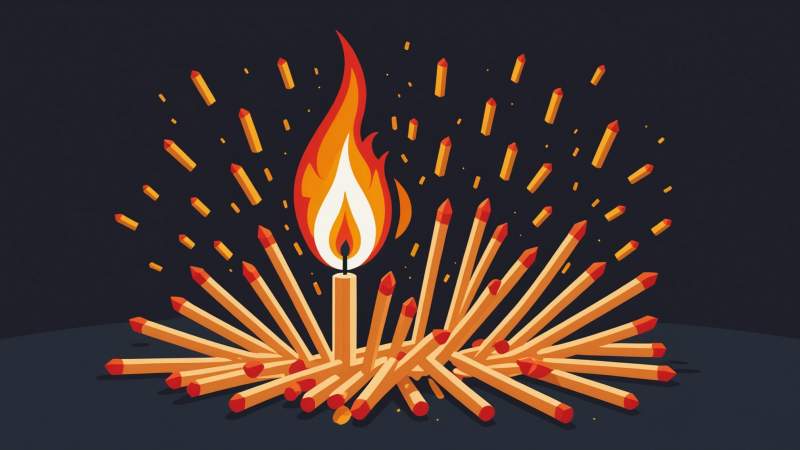
International Match Day is celebrated every year on 2 March to acknowledge the significance of matches in human history. Matches are simple tools consisting of a combustible stick with a head designed to ignite fire.
Before matches, fire was obtained through methods such as friction or striking flint and steel, which required skill and effort. The invention of matches revolutionised fire-making by providing a convenient and portable source of flame.
The development of matches involved various chemical discoveries and innovations, including the use of phosphorus and other compounds. Over time, safer and more reliable matches were created, leading to widespread use and industrial production.
Date of Celebration
International Match Day is observed annually on the 2nd of March. This specific date is dedicated to recognising and commemorating the significance of matches worldwide. The consistent annual celebration on this day highlights the cultural and historical importance attributed to matches as a simple yet essential tool.
History and Development of Matches in Australia
In Australia during the 1920s, the match manufacturing industry was marked by the troubling use of child labour, with children as young as 11 employed in factories. This exploitation prompted significant social concern and led to investigations that ultimately spurred reforms in labour laws. The Australian Women Workers’ Union played a pivotal role in campaigning against the exploitation of children in match factories during this period. A landmark development occurred in 1929 when May Wickham became the first female factory inspector in New South Wales, tasked specifically with addressing abuses in match production facilities. Despite these reforms, the Australian match industry faced decline in the following decades. Notably, factories such as Bryant & May in Richmond ceased operations in the 1970s, largely due to the shift towards imported matches. This history reflects both the social challenges and industrial changes that shaped the evolution of match production in Australia.
The Nature and Purpose of the Match
A match is essentially a small stick made from a combustible material, featuring a striking head designed to ignite and produce fire. Historically, before the invention of matches, fire was obtained through more laborious methods such as friction or striking sparks. These traditional techniques, including the use of a firesteel or flint, demanded considerable effort and skill to successfully generate a spark capable of igniting tinder. The match simplified this process by providing a ready-to-use tool that could reliably produce fire with minimal exertion, marking a significant advancement in the accessibility and convenience of fire-making.
Early Inventions and Chemical Discoveries
The development of matches was deeply influenced by significant chemical discoveries and early inventions. White phosphorus, a crucial element in the evolution of matches, was first discovered by the alchemist Brand in 1669. Later, in the late 18th century, the French chemist Claude Berthollet invented berthollet’s salt and demonstrated that flame could be produced through the reaction of sulfuric acid with this compound. Building on these chemical insights, German scientist A. Hankwitz created matches coated with sulfur that ignited upon contact with a small piece of phosphorus. The earliest matches involved dipping the tip of a splint into molten sulfur and then pressing it against tinder to produce fire. In 1805, French chemist Chapsal showcased the first self-igniting matches, whose heads were composed of a mixture of sulfur, berthollet’s salt, and cinnabar. These matches could be ignited using a lens or a drop of sulfuric acid. The first factory dedicated to match production was established in Vienna in 1813. Despite these advancements, early matches remained expensive and hazardous due to the risk of sulfuric acid splashes during ignition.
Development and Issues of Phosphorus Matches
The development of phosphorus matches marked a significant phase in the evolution of match technology. Around 1827 or 1830, a new type of match was created using a mixture of potassium chlorate (berthollate salt), white phosphorus, and glue. These phosphorus matches were highly flammable and could ignite simply by friction against any hard surface, which posed considerable safety risks. Moreover, white phosphorus, a key component in these early matches, was found to be extremely toxic. Due to its hazardous nature, the production of matches containing white phosphorus was eventually prohibited. A safer alternative emerged with the discovery of red phosphorus in 1847, which was non-toxic and addressed many of the health and safety concerns associated with white phosphorus. This transition was crucial in mitigating the dangers linked to early phosphorus matches and paved the way for safer match manufacturing practices.
The Invention of Safety Matches
The invention of safety matches marked a significant advancement in the development of matches, primarily attributed to the work of German chemist Gustaf Erik Pasch and further refined by others. A notable early prototype was created by chemist Bether, who developed a match head composed of potassium chlorate, sulfur, and glue applied to a paraffin-coated splint. To complement this, Bether also devised a special striking surface containing red phosphorus, which was crucial for igniting the match safely. These innovations resulted in matches that produced a steady yellow flame without smoke or unpleasant odours, greatly improving user experience and safety.
The first production of these safety matches began in Sweden in 1851, undertaken by the Lundström brothers. Due to their origin, these matches were commonly referred to as Swedish matches for an extended period. Their quality and innovation were internationally recognised when Swedish safety matches were awarded a gold medal at the International Exhibition in Paris in 1855. This accolade underscored the importance of the safety match as a safer and more reliable alternative to earlier match designs.
Modern Matches
Modern matches have undergone significant improvements in their chemical composition to enhance safety and environmental compatibility. Unlike earlier versions, contemporary matches do not contain sulfur or chlorine compounds. Instead, they utilise paraffins and chlorine-free oxidisers, which contribute to a cleaner and more controlled ignition process. This shift in materials reflects advancements in match manufacturing aimed at reducing harmful emissions and improving user safety, while maintaining the fundamental function of the match as a reliable source of flame.