Brazil Discovery Day and the Portuguese Arrival in 1500
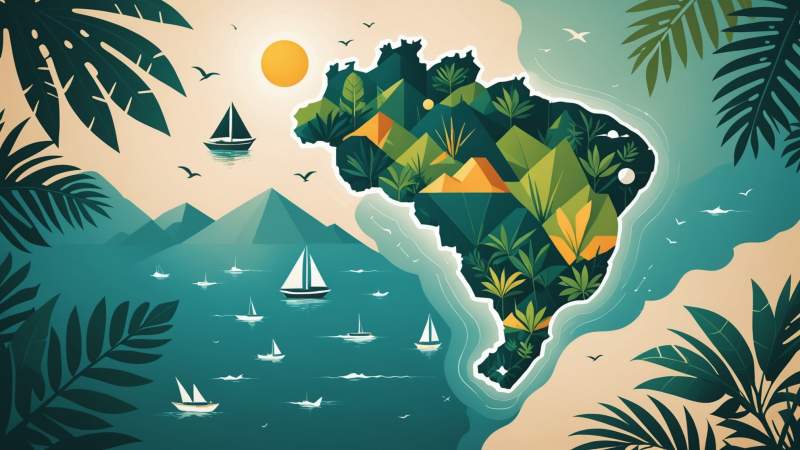
Brazil Discovery Day is celebrated annually on 22 April to mark the arrival of Portuguese explorer Pedro Álvares Cabral on the South American coast in 1500. This landing initiated the formal claim of Brazil by Portugal under the terms of the Treaty of Tordesillas.
At the time of European arrival, Brazil was inhabited by indigenous peoples who lived semi-nomadic lives, engaging in hunting, fishing, and agriculture. The Portuguese expedition led by Cabral was the first significant European contact with the region.
Following the discovery, the Portuguese crown established colonial administration, dividing the territory into captaincies and later appointing governors and viceroys. This laid the foundation for Brazil’s development as a Portuguese colony and its eventual path to independence.
Date of the Holiday
Brazil Discovery Day is celebrated annually on the 22nd of April. This date marks the official commemoration of the event when Brazil was first discovered. The choice of this specific day serves as a fixed point in the calendar to honour the historical significance of Brazil’s discovery.
Analogies with Australia
The historical trajectories of Brazil and Australia reveal several notable analogies, particularly in the context of European discovery and subsequent colonial administration. James Cook’s proclamation of the eastern coast of Australia as British Crown territory on 22 August 1770 serves as a parallel to the Portuguese discovery of Brazil. Both lands were inhabited by indigenous peoples long before European arrival, with Australian Aboriginals having settled the continent approximately 65,000 years ago, mirroring the longstanding presence of Brazil’s native populations.
Geographically, Australia shares borders with Indonesia and Papua New Guinea, much like Brazil’s extensive frontiers with numerous South American countries. Following discovery, both territories were governed as colonies under their respective European crowns: Australia under British colonial rule until federation in 1901, and Brazil under Portuguese administration until its independence. The appointment of Arthur Phillip as the first Governor-General of Australia in 1788 reflects a governance structure akin to the captaincies led by general-captains in Brazil.
The colonial organisation further aligns with Brazil’s division into captaincies; in the 1820s, Australia was partitioned into several colonial captaincies. Indigenous populations in both regions were utilised as labour forces during early colonisation phases, with Australian Aboriginals and Brazilian indigenous peoples playing comparable roles prior to the introduction of African slaves in Brazil.
Australia’s progression to nationhood also parallels Brazil’s path: the federation of Australia in 1901, marked by the adoption of a constitution and the establishment of a dominion status, resembles the Brazilian Empire’s formation. Later, Australia became a republic following a 1999 referendum, although the British monarch remains the formal head of state, a situation reminiscent of Brazil’s abolition of the monarchy in 1889. These analogies underscore shared patterns in the colonial and post-colonial histories of Brazil and Australia.
Geography and Population of Brazil
Brazil is a Federative Republic located in South America and stands as the largest country on the continent, occupying nearly half of South America’s total land area. It is unique in the Americas as the only Portuguese-speaking nation. The territory of Brazil has been inhabited since prehistoric times. Prior to the arrival of Europeans, the indigenous population led a semi-nomadic lifestyle, engaging in hunting, fishing, and agriculture.
Background to the Discovery of Brazil
The discovery of Brazil is closely linked to the geopolitical arrangements between Spain and Portugal in the late 15th century. In 1494, the two Iberian powers signed the Treaty of Tordesillas, which established a demarcation line dividing their respective spheres of influence in the newly encountered lands. This line crossed the largely unexplored South American continent, effectively partitioning the territory between the two kingdoms. According to the terms of the treaty, the lands east of this demarcation line, including the area that would later be known as Brazil, were assigned to Portugal. This agreement laid the legal groundwork for Portuguese claims to the region prior to its formal discovery and subsequent colonisation.
Pedro Álvares Cabral’s Expedition
King Manuel I of Portugal appointed Pedro Álvares Cabral as the admiral of the second Portuguese fleet destined for India. On 9 March 1500, Cabral set sail from Lisbon commanding a fleet of thirteen ships with a crew of approximately 1,200 men. To avoid the calm waters along the African coast, Cabral deliberately chose a more westerly route. This decision led his expedition to become the first significant Portuguese voyage to reach the shores of South America. On 22 April 1500, Pedro Álvares Cabral and his fleet made landfall on the South American coast, marking a pivotal moment in the history of Portuguese exploration.
Discovery and Colonisation of Brazil
Upon arrival, Pedro Álvares Cabral declared the newly discovered lands as the property of the Portuguese crown, initially naming them the Island of Vera Cruz. However, once it was realised that the territory was not an island but a coastline, the name was changed to the Land of Santa Cruz. This area became the site of the first Portuguese colonies in South America. To organise the administration and settlement of the territory, the Portuguese divided the Brazilian coast into fifteen captaincies. Portuguese settlers began to arrive in Brazil, establishing a colonial presence. In the early stages of colonisation, the labour force primarily consisted of the indigenous peoples, but over time, enslaved Africans were brought in to meet the growing demand for workers.
Governance and Independence of Brazil
In 1549, the territories of Brazil came under the direct authority of the King of Portugal. The administration of Brazil was carried out on behalf of the king by a general-captain, who held immediate governance over the colony. This system evolved in 1640 when the position of viceroy was established to govern Brazil, with the first viceroy being the Marquis of Montalvan. A significant moment in Brazil’s governance occurred in 1806 when King João VI of Portugal fled to Brazil to escape Napoleon’s invasion. He remained in Brazil until 1821, after which he returned to Portugal. Upon his departure, João VI left his son as regent on the Brazilian throne. This son later declared Brazil’s independence from Portugal on 7 September 1822, proclaiming himself Emperor Pedro I. The Brazilian Empire, established under his rule, lasted until 1889. That year, Emperor Pedro II was overthrown by the military, who subsequently declared Brazil a republic. This transition marked the end of monarchical rule and the beginning of republican governance in Brazil.