Synaxis of the Twelve Apostles in Orthodox Christianity
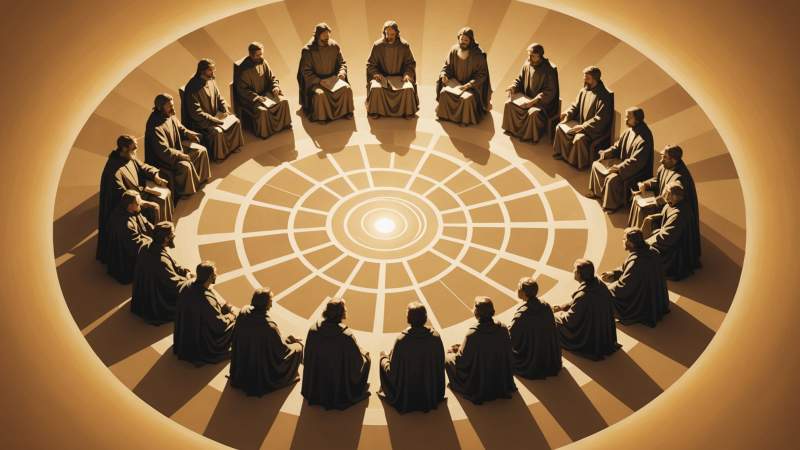
The Synaxis of the Twelve Apostles is one of the most significant feasts in the Orthodox Christian liturgical calendar, observed annually on 13 July. It honours the twelve closest disciples of Jesus Christ — the men who formed the living foundation of the early Church and carried the Gospel across the ancient world.
This feast follows directly after the commemoration of the foremost apostles Peter and Paul (12 July) and is marked by special liturgical services, including an all-night vigil and Divine Liturgy. Rather than celebrating each apostle individually, the Synaxis gathers them into a single, unified remembrance — a collective act of gratitude and veneration.
As Orthodox theologians observe, the Synaxis of the Twelve Apostles is not simply a calendar entry — it is the Church’s formal recognition that no single apostle built Christianity alone, but that all twelve, together, laid its cornerstone.
The lives and deeds of the apostles are detailed in the four Gospels and the Acts of the Apostles. Orthodox churches around the world, including those in Australia, celebrate this feast with specific rites, hymns, and prayers rooted in centuries of continuous tradition.
Date and Liturgical Celebration of the Synaxis
The Orthodox Church commemorates the Synaxis of the Twelve Apostles on 13 July each year. This date is deliberately chosen to follow the feast day of the foremost apostles, Peter and Paul, which is observed on 12 July. Placing the Synaxis immediately after ensures a theological continuity: after honouring the two most prominent apostles, the Church turns to honour the entire apostolic college.
The Synaxis functions as a collective memorial, distinct from the individual feast days dedicated to each apostle at various points in the liturgical year. This dual structure — individual and collective commemoration — reflects Orthodox Christianity’s understanding of both personal holiness and communal witness.
The liturgical observance follows a well-defined structure:
- All-night vigil on the eve of the feast, preparing the faithful through extended prayer, Scripture readings, and hymnody.
- Divine Liturgy on the morning of 13 July, the central Eucharistic service of the celebration.
- Moleben — a special intercessory prayer service offered in honour of the apostles collectively.
The liturgical service for the Synaxis is celebrated according to a unique rite, combined with the Octoechos — the liturgical book containing hymns organised across eight tones, used cyclically throughout the liturgical week. This combination gives the feast a richness of hymnographic expression that reflects both its solemnity and its joy.
Celebration in Australia
In Australia, the Synaxis of the Twelve Apostles is honoured through dedicated Orthodox Christian institutions and active places of worship. Melbourne is home to the Antiochian Orthodox Church of the Holy Twelve Apostles, which serves as a spiritual centre for the faithful in the region. Sydney likewise hosts a church named after the Twelve Apostles, reflecting the feast’s significance within the local Orthodox community.
These parishes represent a broader global tradition of constructing Orthodox temples specifically dedicated to the Synaxis of the Twelve Apostles — a practice found across Eastern Europe, the Middle East, and increasingly in diaspora communities across the English-speaking world. Their presence in Australia underscores the living continuity of Orthodox worship far beyond its historical heartlands.
Who Are the Twelve Apostles?
The Synaxis commemorates the twelve closest disciples chosen by Jesus Christ during His earthly ministry to be His primary followers and messengers to the world. Their lives and missions are documented in the Gospels and the Acts of the Holy Apostles.
The original twelve are listed below, along with key identifying details:
| Apostle | Notable Detail |
|---|---|
| Peter (Simon) | Fisherman from Capernaum; foremost among the twelve |
| Andrew | Peter’s brother; called “the First-Called” |
| John, son of Zebedee | Known as “the Theologian”; youngest apostle |
| James, son of Zebedee | John’s brother; martyred c. 44 AD |
| Philip | From Bethsaida; one of the first called |
| Bartholomew | Often identified with Nathanael in the Gospels |
| Matthew | Former tax collector; author of the First Gospel |
| Thomas | Known as “Doubting Thomas” for questioning the Resurrection |
| James, son of Alphaeus | Known as “James the Less”; brother of Matthew |
| Jude Thaddeus (Jude James) | Son of Joseph the Betrothed from his first marriage |
| Simon the Zealot | Formerly associated with the Zealot movement |
| Judas Iscariot | Betrayed Christ for thirty pieces of silver; later replaced |
Notably, two of the twelve bore the name Jude. Jude Thaddeus, also known as Jude James, was the son of the righteous Joseph the Betrothed from his first marriage — a detail that connects him closely to the broader family of the Holy Family.
Judas Iscariot is infamous for betraying Christ by handing Him over to the chief priests for thirty pieces of silver. His name has since become synonymous with betrayal in many languages and cultures. Following his act of treachery and subsequent death, his place among the twelve was filled by Matthias, who was chosen by the apostolic community through the casting of lots — an event recorded in Acts 1:23–26.
Peter, Andrew, and John: The Inner Circle
Among the Twelve, three apostles are consistently presented in the Gospels as occupying the innermost circle of Christ’s disciples: Peter, Andrew, and John.
The Apostle Peter holds the foremost position among the twelve. Originally named Simon, he was a fisherman from Capernaum on the Sea of Galilee and was among the first to recognise Jesus as the Messiah. Despite his painful denial of Christ on the night of the arrest — a moment he later wept over bitterly — Peter repented and was fully restored, eventually becoming the leading voice of the early Church in Jerusalem and beyond.
The Apostle Andrew, Peter’s brother, was also a fisherman and one of the earliest disciples. Before encountering Jesus, Andrew had been a follower of John the Baptist. He became the first to follow Christ after His Baptism, earning the permanent epithet “the First-Called” (Protokletos). His role underlines the direct theological link between the ministry of John the Baptist and the beginning of Christ’s public mission.
The Apostle John, son of Zebedee, is known in Orthodox tradition as “the Theologian” — a title reserved for those considered to have penetrated most deeply into divine mysteries. Like Andrew, John had been a disciple of John the Baptist before following Christ. He was the youngest of the twelve and is described in the Gospel as “the beloved disciple.” John holds a unique distinction: he was the only apostle present at the Crucifixion, and after Christ’s death he took personal responsibility for the care of the Virgin Mary. He is credited with authoring the Fourth Gospel, three epistles, and the Book of Revelation. Uniquely among the apostles, John died a natural death in old age — all others are venerated as martyrs.
Thomas, Matthew, and the Diversity of the Apostolic College
The remaining apostles represent a striking diversity of backgrounds, temperaments, and histories — a diversity that Orthodox Christianity sees as intentional, reflecting the universality of the Gospel’s call.
The Apostle Thomas, widely known by the epithet “Doubting Thomas,” is notable for his initial and frank scepticism about the Resurrection. He declared he would not believe unless he personally touched the wounds of the risen Christ. When Jesus appeared to him specifically and offered exactly that, Thomas responded with one of the most profound confessions in the New Testament: “My Lord and my God” (John 20:28). Far from being a cautionary tale, Thomas’s story is understood in Orthodox tradition as a model of honest seeking that leads to deep faith.
The Apostle Matthew, nicknamed “the Tax Collector,” came from a profession widely despised in first-century Jewish society, as tax collectors worked for the Roman occupiers and were often associated with corruption. His response to Christ’s call was immediate — he rose and followed without delay. Matthew is traditionally recognised as the author of the First Gospel, which is structured particularly for a Jewish-Christian audience and draws heavily on Hebrew Scripture to present Jesus as the fulfilment of prophecy. His brother James the Less (James son of Alphaeus) was also among the twelve, making theirs one of several sibling pairs in the apostolic group.
- The apostolic college included at least two pairs of brothers: Peter and Andrew, and James and John (sons of Zebedee).
- Matthew and James the Less were also brothers, adding a third family connection among the twelve.
- The group included fishermen, a tax collector, a former Zealot, and others of unknown occupation — a cross-section of Galilean society.
Together, the twelve apostles honoured on 13 July represent not a curated group of the already-holy, but ordinary men transformed by extraordinary encounter — a theme central to Orthodox Christian anthropology and one that continues to give the Synaxis its enduring spiritual meaning.