
New Year’s Eve Traditions and Celebrations in Australia
New Year’s Eve is observed globally on 31 December, marking the transition to a new calendar year. This tradition dates back thousands of years to ancient Babylonian and Roman celebrations.
In Australia, New Year’s Eve is not a public holiday, but many offices reduce working hours to allow for preparations and celebrations. The day is dedicated to reflecting on the past year and planning for the future.
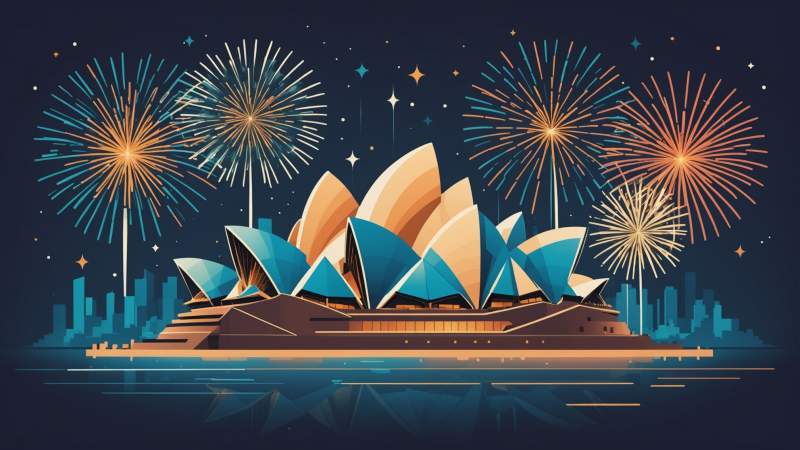
Australian cities, especially Sydney, are renowned for their spectacular fireworks displays and public events. These celebrations often take place outdoors, taking advantage of the summer weather and include family-friendly activities and large-scale public gatherings.
Date and General Traditions
New Year’s Eve is celebrated annually on 31 December worldwide. This date has become synonymous with preparing to welcome the New Year, reflecting on the past year, and planning for the future. The evening of 31 December is dedicated to these preparations, serving as a time to conclude the year’s events and set intentions for the year ahead. Common practices on this day include reviewing the year’s achievements and challenges, creating lists of goals for the upcoming year, preparing gifts or surprises for loved ones, and making wishes for the future. These activities collectively characterise 31 December as a moment of transition and anticipation, marking the close of one year and the hopeful beginning of another.
Historical Roots of the Celebration
The tradition of celebrating New Year’s Eve dates back thousands of years. Ancient civilizations such as the Babylonians and Romans held grand festivities to mark the arrival of a new calendar cycle. These early celebrations laid the foundation for the enduring practice of welcoming the new year with communal events and rituals, reflecting humanity’s long-standing desire to acknowledge the passage of time and the promise of renewal.
General New Year’s Customs and Traditions
The preparations for New Year’s Eve commonly involve a variety of customs that centre around gift-giving, decorating the Christmas tree, exchanging New Year’s greetings, and sending invitations to gatherings. Across many cultures, the New Year’s table is adorned with traditional treats that hold symbolic meaning, such as Olivier salad and grapes, which are believed to bring good fortune. A notable example is the Spanish tradition of eating twelve grapes, one with each stroke of the clock at midnight, symbolising luck for each month of the coming year. Additionally, in numerous countries, public institutions either close or operate only until midday on 31 December, allowing people to focus on their celebrations and preparations for the New Year.
New Year’s Eve in Australia: Features and Traditions
In Australia, New Year’s Eve is celebrated on 31 December according to the Gregorian calendar. Unlike some other countries, it is not a nationwide public holiday; however, many offices and organisations in major cities often shorten their working hours on this day. Given that New Year’s Eve falls during the Australian summer, celebrations frequently take place outdoors, particularly on beaches and in open-air settings.
Fireworks are a prominent feature of New Year’s Eve festivities across Australia. Despite their popularity, the sale and private use of consumer fireworks are restricted or prohibited in most states. For example, in New South Wales, private fireworks displays require a special licence, resulting in the majority of residents attending official public shows organised by authorities. These official displays are a central attraction of the evening.
Safety measures are heightened on New Year’s Eve, with increased police patrols in areas hosting large gatherings to ensure public order. Alcohol consumption is a common aspect of New Year’s parties, though special regulations often apply in event zones to manage its use responsibly. In major cities, the night is marked by large-scale street celebrations, concerts, and family picnics held in parks and along waterfronts, creating a vibrant and communal atmosphere to welcome the new year.
New Year’s Celebrations in Sydney
Sydney is renowned for its spectacular New Year’s Eve celebrations, featuring two major fireworks displays on 31 December. The festivities begin with a family-friendly fireworks show around 9:00 pm, followed by the main event at midnight. Among Australia’s most famous New Year’s fireworks, the display over Sydney Harbour and the iconic Harbour Bridge stands out as a highlight attracting large crowds. Due to the scale of the celebrations, a special traffic management system is implemented on New Year’s Eve, including road closures and restrictions around Sydney Harbour to accommodate the influx of visitors. Access to popular vantage points for viewing the fireworks is controlled through ticketing or early entry systems, ensuring orderly crowds and a safe environment for spectators eager to witness the midnight spectacle.